
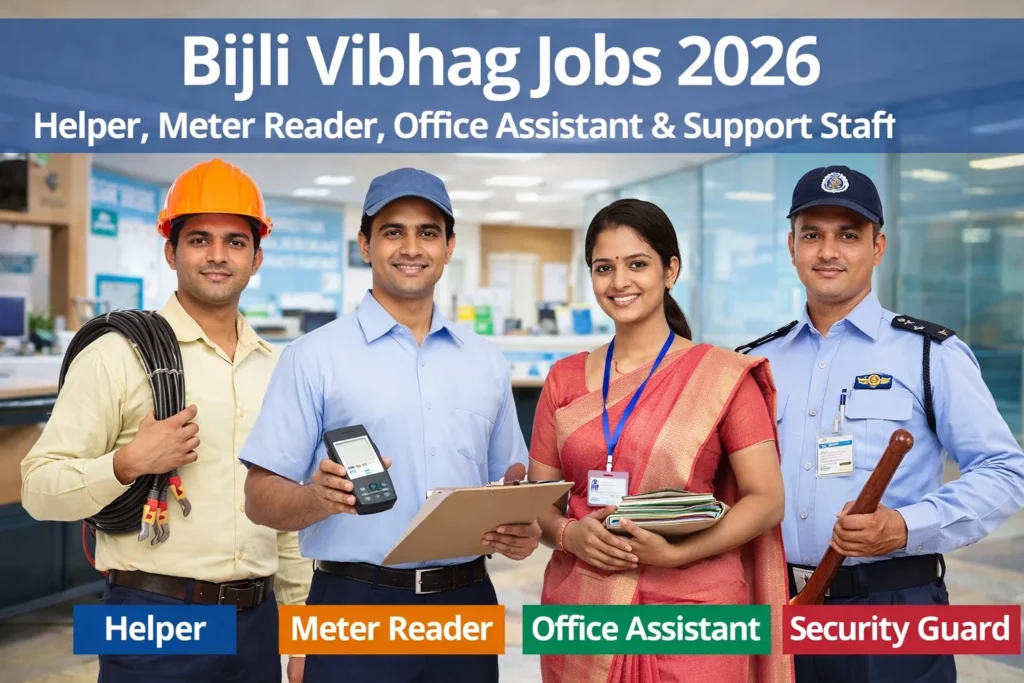
The power sector is the lifeblood of India’s economy, and electricity departments—both state-run and private distribution companies—form the backbone of this critical infrastructure. As we move through 2026, the demand for skilled and semi-skilled personnel in the power sector remains robust, with utilities across the country ramping up recruitment to meet growing energy demands, improve service delivery, and modernize operations. For candidates seeking stable government and public sector employment, electricity department jobs offer a reliable career path with competitive benefits, job security, and opportunities for growth.
Whether you are a fresh graduate, a candidate with a high school education, or someone with vocational training, the power sector provides diverse entry points. From field roles such as helper and meter reader to office-based positions like office assistant and support staff, these jobs are essential to ensuring that millions of households and businesses receive uninterrupted electricity service. This guide provides a comprehensive blueprint for candidates seeking to secure positions in electricity departments across India in 2026.
Understanding the Power Sector Landscape
India’s electricity sector is a complex ecosystem comprising generation, transmission, and distribution. Recruitment for frontline and support staff typically occurs at the distribution level—the state electricity boards and private discoms that serve consumers. State-owned power utilities such as Maharashtra State Electricity Distribution Company, Uttar Pradesh Power Corporation, Tamil Nadu Generation and Distribution Corporation, and others regularly conduct recruitment drives for non-executive and support staff positions.
These roles are critical to daily operations. Helpers assist with field maintenance and repairs, meter readers record consumption data, office assistants manage administrative tasks, and support staff ensure smooth functioning of departmental offices. Unlike highly specialized engineering roles, these positions are accessible to candidates with varying educational backgrounds, making them a popular choice for job seekers across the country.
Key Roles and Salary Expectations
To help you navigate the current recruitment landscape, the table below outlines common electricity department roles available in 2026, along with typical responsibilities and average monthly salary ranges. Please note that salaries vary based on state, utility type (state government or private discom), pay commission recommendations, and years of service.
| Job Title | Typical Responsibilities | Average Entry-Level Salary Range (Per Month) |
|---|---|---|
| Helper | Assist linemen with maintenance work, carry tools and materials, support field operations, ensure safety compliance, clean and maintain work areas | ₹15,000 – ₹25,000 |
| Meter Reader | Record electricity consumption readings from residential and commercial meters, update records, report discrepancies, interact with consumers | ₹18,000 – ₹28,000 |
| Office Assistant | Manage correspondence, maintain files and records, assist with billing and documentation, coordinate between departments, handle phone calls and visitors | ₹20,000 – ₹32,000 |
| Junior Assistant / Clerk | Process applications, maintain computer records, prepare reports, handle customer inquiries, assist with billing and revenue collection | ₹22,000 – ₹35,000 |
| Technical Helper / Fitter Assistant | Assist with transformer maintenance, support repair work, handle basic tools, assist in fault location and rectification | ₹18,000 – ₹30,000 |
| Customer Service Representative | Address consumer complaints, provide billing assistance, guide consumers on schemes and applications, manage service requests | ₹20,000 – ₹32,000 |
| Data Entry Operator | Enter consumption data, update consumer records, maintain digital databases, verify accuracy of information, generate reports | ₹18,000 – ₹28,000 |
| Security Guard / Watchman | Ensure security of departmental premises, monitor entry and exit, maintain visitor logs, assist during emergencies | ₹15,000 – ₹22,000 |
| Driver | Operate departmental vehicles, transport staff and equipment, maintain vehicle logs, ensure timely delivery of materials | ₹18,000 – ₹28,000 |
These roles offer not just monthly salaries but also additional benefits such as dearness allowance, house rent allowance, medical benefits, and pension schemes in government utilities. With experience and departmental examinations, employees can progress to higher positions such as Junior Engineer, Assistant Accountant, or Office Superintendent over time.
Eligibility Criteria and Educational Qualifications
Eligibility for electricity department jobs varies by role and state utility. Generally, the following educational qualifications are required:
- Helper and Support Staff: Class 10 or Class 12 pass from a recognized board. Basic literacy and physical fitness are often required.
- Meter Reader: Class 12 pass, often with preference for candidates with basic computer knowledge. Some utilities require a two-wheeler driving license.
- Office Assistant / Clerk: Class 12 pass or graduate degree, with proficiency in computer applications, typing skills, and knowledge of local language.
- Technical Roles: ITI certification in relevant trades such as electrician, wireman, or fitter is often required.
Candidates must also meet age criteria, typically ranging from 18 to 35 years, with relaxations for reserved categories as per government norms. Recruitment is conducted through written examinations, skill tests, and interviews.
Building a Competitive Edge
In a highly competitive recruitment environment, meeting minimum eligibility is rarely enough to secure a position. Candidates who prepare strategically have a significant advantage. Begin by thoroughly reviewing the notification released by your state electricity board or discom. Understand the exam pattern, syllabus, and selection process.
Preparation should focus on:
- General Knowledge and Current Affairs: State-specific and national current affairs, especially related to the power sector.
- Reasoning and Quantitative Aptitude: Basic numerical ability, logical reasoning, and data interpretation.
- Technical Knowledge: For technical roles, fundamentals of electricity, safety practices, and basic electrical concepts.
- Computer Proficiency: Basic computer operation, typing speed, and familiarity with office software.
Additionally, physical fitness is essential for field roles such as helper and meter reader, which require walking, climbing, and working in outdoor conditions.
Navigating the Recruitment Process
Electricity department recruitment in 2026 follows a structured process. State utilities release notifications on their official websites and through employment news. Candidates must carefully read eligibility criteria, application deadlines, and document requirements. Applications are typically submitted online, followed by a written examination, skill test, and document verification.
It is crucial to beware of fraudulent recruitment agents promising jobs in exchange for money. All legitimate recruitment for government electricity departments is conducted through transparent, merit-based processes. Candidates should rely only on official notifications and avoid intermediaries.
Once selected, candidates undergo training before being posted to field offices, substations, or divisional offices. Initial postings may be in rural or semi-urban areas, with opportunities for transfers over time.
Embracing a Career of Service and Stability
Working in the power sector is more than just a job—it is a role that directly impacts the lives of citizens. Electricity department employees ensure that hospitals have power, industries can operate, and homes remain lit. The work can be challenging, involving outdoor duties, emergency responses, and dealing with consumer concerns. However, the rewards are substantial: job security, pension benefits, fixed working hours, and the satisfaction of serving the community.
For candidates seeking stability and a government career, electricity department roles are an excellent choice. The path requires patience, preparation, and perseverance. With the right approach, these positions can serve as a foundation for a long and fulfilling career in the public sector.
As you prepare for Bijli Vibhag recruitment in 2026, remember that success comes to those who plan diligently, stay informed, and remain committed to their goal. The power sector is waiting for dedicated individuals ready to contribute to India’s energy mission—and your journey begins with the first step of preparation.